act 181, explained
From policy to maps to real-world impact—here’s what you need to know, all in one place.
WHAT IS ACT 181? in plain english
Act 181, sponsored by Amy Sheldon, is a major update to Vermont’s land use framework that changes how and where development is regulated across the state.
At its core, Act 181 expands when and where Act 250 jurisdiction applies. In other words, it does not replace Act 250; it broadens the situations in which the Act 250 permitting process is triggered.
A Shift in How Land Is Regulated
Instead of focusing primarily on the size of a project (as Act 250 has done for decades), Act 181 shifts to a system based on location. Where your land is now plays a much larger role in determining what you can do with it.
This means that even smaller projects may now require Act 250 review, depending on where they are located and how access (such as roads) is developed.
Mapping-Based Decisions
The law relies heavily on statewide mapping to determine these outcomes, rather than site-specific, on-the-ground evaluation.
Rural landowners were not consulted before these changes were put in place, despite the direct impact on their land. As more people review the maps, concerns are growing about how they were created and whether they accurately reflect the realities of Vermont’s landscape and it's people.
A Quick Look Back: What Is Act 250?
Act 250 was passed in 1970 to protect Vermont’s environment and rural character from large-scale, unmanaged development. For over 50 years, it worked like this:
- Projects triggered review based on size (e.g. number of homes or acres disturbed)
- Smaller, low-impact projects often did not require state permits
Act 181 changes this approach.
The Big Shift: From Size TO Location
Act 181 divides Vermont into three “tiers,” which determine how easy or difficult it is to build:
Tier 1 — Growth Areas
- Downtowns and village centers
- Now mostly exempt from Act 250
- Designed to encourage housing and development
Tier 2 — Everything Else
- Most of rural Vermont
- Existing Act 250 rules still apply
- New rules (like the road rule) are layered on top
Tier 3 — "Sensitive" Areas
- Wildlife corridors
- Headwater streams
- Forest blocks and habitat areas (read more about this languaging)
Tier 3 areas may face stricter review regardless of size. This means even small projects (like building a home) could trigger state review depending on location.
The Road Rule (Starts July 1, 2026)
One of the most debated parts of Act 181 is the new road length trigger.
Under this rule, Act 250 review may be triggered if:
- A road or driveway exceeds 800 feet, or
- A network of roads totals 2,000 feet or more
There is also significant confusion around how the rule applies to properties with existing or planned structures. Some guidance suggests that projects involving three or fewer dwellings or structures may not trigger Act 250 under certain conditions. However, this is not a simple exemption.
Key factors may include:
- Whether the structures are part of a single development or plan
- Whether roads serve current and future buildings
- Whether the land is under common ownership or control
Just as importantly, it remains unclear in many cases:
- What is considered “grandfathered”
- How existing driveways and structures are counted
- How future additions (such as a fourth home or outbuilding) may change jurisdiction
In other words, even properties with only a few structures today may still face uncertainty depending on how the rule is interpreted.
Wildlife Corridors & Mapping
Act 181 relies heavily on statewide mapping to identify:
- Wildlife movement corridors
- Habitat areas
- Headwaters and natural resources
These mapped areas are used to determine Tier 3 designations.
Key issue:
- Many of these maps are still being finalized
- Landowners may not yet know if their property will be affected
- A great deal of Vermont's land is already under some kind of protection:
- 25% is permanent protected
- 25-35% is managed (UVA, working lands)
- 60-80% is influenced by ecological/regulatory constraints
Why People Are Paying Attention
Supporters say Act 181 will:
- Protect natural resources
- Prevent sprawl
- Encourage development in existing town centers
Others are concerned that it may:
- Shift decision-making away from local communities
- Add complexity and cost to small projects
- Disproportionately impact rural landowners
- Decrease property values
- Create uncertainty while rules and maps are still evolving
This link takes you to Act 181 (scroll down on the page to see the vote roll call)
KEY ADVOCATES OF ACT 181
Amy Sheldon
Lead sponsor of Act 181
Vermont House of Representatives
Chair of the House Committee on Environment and Energy
Seth Bongartz
Ranking member of the House the House Committee on Environment and Energy
Anne Watson
Co-sponsor of Act 181
Vermont State Senate, Washington District
Chris Bray
Vermont State Senate, Addison County
Committee leadership: Chair, Senate Natural Resources and Energy Committee
Lauren Hierl
Executive Director
Vermont Natural Resources Council (VNRC)
Vermont Natural Resources Council (VNRC)
Unelected advocacy organization
Played a significant role in shaping Act 181 and promoting its passage
Agency of Natural Resources (ANR)
State agency
Supports environmental protection and contributes to mapping and rulemaking
Smart Growth America (influence / alignment)
National organization
Promotes land use models similar to Act 181’s growth-centered approach
VOICES RAISING CONCERN
Vermont Landowners & Residents (Statewide)
Individual voices
Farmers, builders, and rural property owners
Vermont Farm Bureau
Statewide agricultural organization
Raised concerns about the road rule’s impact on farms and rural landowners in legislative testimony.
Mary White
President
Vermont Farm Bureau.
Spoke publicly about how the road rule may harm rural communities and working lands.
Vermont Rural Caucus
Group of rural legislators
Hosted listening sessions to hear concerns from Vermonters impacted by Act 181.
Mark Higley
Vermont State Representative
(House)
Represents a rural district and has expressed concerns about how land use regulations may affect property owners.
Russ Ingalls
State Senator (Essex-Orleans District)
Has raised concerns about how Act 181 affects rural communities and the balance between conservation and land use.
Terry Williams
State Senator (Rutland County)
Has expressed concern about regulatory burden and impacts on rural districts.
Rural Vermont Rising
A group of 8000+ and growing who are organizing efforts to better understand and take action around Act 181.

2026 Timeline: Key Events & Decisions
WHERE WE STAND TODAY (AS OF APRIL)
CHANGE is being driven by Vermonters.
Following a surge of public testimony and sustained engagement from rural communities, lawmakers are now openly reconsidering Tier 3 and the road rule components of Act 181. In a recent House Environment Committee meeting, Amy Sheldon stated:
“I’m looking at repealing the road rule and the Tier 3 and revisiting how we structure that.”
This marks a significant shift - and one that came directly after clear, consistent concerns were raised by Vermonters on the ground.
The focus now turns to S.325, which is currently being revised in the House Environment Committee.
Lawmakers are actively updating the language, including potential repeal of the road rule and Tier 3.
The revised bill will need to go to a full House vote. It would then move to the Senate (or back to the Senate for agreement, depending on prior versions)
The process is still unfolding. Vermonters must stay vigilant and informed.
MARCH 11, 2026 — FARM BUREAU TESTIMONY
The Vermont Farm Bureau presented testimony to the Senate Natural Resources Committee raising concerns about how the proposed road rule could impact rural landowners and working farms.
They highlighted that long driveways and access roads are common in agricultural settings, and that fixed thresholds may disproportionately affect those building on rural land.
As Farm Bureau President Mary White stated, “In rural Vermont, we measure land in acres, not feet.”
MARCH 24, 2026 — STATEHOUSE REPEAL ACT 181 RALLY
Vermonters gathered at the Statehouse to voice concerns about Act 181 and its potential impacts on rural communities, property rights, and future development.
The rally brought together landowners, tradespeople, and residents from across the state, reflecting growing awareness and concern as implementation timelines approach.
It marked one of the first visible, organized responses to the law and its anticipated effects.
YouTube clip of the Repeal Act 181 Rally
MARCH 26, 2026 — S.325 PASSES SENATE
A bill (S.325) proposing to delay parts of Act 181, including the Tier 3 implementation timeline, passed the Vermont Senate.
The bill reflects growing concern about how the law will impact landowners and whether key elements are ready to be implemented as scheduled.
The proposal is not yet final and must still pass the House and be approved by the Governor before any changes take effect.
View bill details →
APRIL 1, 2026 — RURAL CAUCUS LISTENING SESSION
Members of the Vermont Rural Caucus held a listening session to hear directly from Vermonters about how Act 181 is affecting rural communities.
Landowners, farmers, and residents shared concerns about the road rule, Tier mapping, and the uncertainty surrounding implementation timelines.
The session reflects growing engagement from both lawmakers and the public as the impacts of Act 181 become more widely understood.
Link to recorded meeting coming soon
APRIL 30, 2026 — PUBLIC COMMENT DEADLINE
Public comments are due to the Land Use Review Board on draft guidance for Act 181, including the road rule.
This provides an opportunity for Vermonters to weigh in on how the law is interpreted and implemented. However, key elements — including thresholds and timelines — are still being debated and may change through pending legislation.
As a result, many are being asked to comment on a framework that is still evolving.
View materials and submit comments →
Act 181 guidance documents →
MAY 2026 (EXPECTED) — DELAY DECISION PENDING
A bill (S.325) proposing to delay parts of Act 181, including the Tier 3 implementation timeline, has passed the Senate and is awaiting action in the House and by the Governor.
If approved, key dates would be pushed back. If not, Act 181 will proceed on its current timeline, with major provisions taking effect in 2026.
As of now, the outcome remains uncertain — leaving landowners, builders, and communities unsure which timeline to plan for.
View bill status →
JULY 1, 2026 — ROAD RULE TAKES EFFECT
The new road rule under Act 181 is scheduled to take effect on July 1, 2026.
Under this rule, construction of a road or driveway exceeding certain thresholds (including 800 feet) can trigger Act 250 review — even in cases where no other development thresholds would otherwise apply.
While some aspects of Act 181 may be delayed through pending legislation (S.325), the road rule is currently scheduled to move forward on this timeline.
This has raised concerns for rural landowners, where longer driveways are common due to parcel size, terrain, and access.
“When Act 250 is triggered solely due to the construction of a road in Tier 2…”
In other words: a road alone can trigger Act 250 — even if nothing else would.
Watch discussion (2:51:07) →
View Act 181 materials →
DECEMBER 31, 2026 — TIER 3 TAKES EFFECT
Under current law, Tier 3 designations — which place additional restrictions on certain mapped lands — are scheduled to take effect at the end of 2026.
These maps are still being developed and finalized, meaning many landowners do not yet know whether their property will be affected.
A proposed bill (S.325) would delay this timeline to June 30, 2028, but that change has not been finalized. Until then, the December 2026 effective date remains in place.
View Act 181 details → https://legislature.vermont.gov/bill/status/2024/H.687
View proposed delay (S.325) →
How We Got Here
MAY 10, 2024 — ACT 181 PASSES LEGISLATURE
Passed largely along party lines (House 84–56, Senate 19–9). VIEW VOTES
JUNE 14, 2024 — GOVERNOR VETOES ACT 181
Governor Scott vetoes the bill, citing concerns about impacts on rural growth. LEARN MORE
JUNE 17, 2024 — VETO OVERRIDDEN
Legislature overrides the veto (House 103–42, Senate 21–8), enacting Act 181 into law. VIEW VOTES
2025 — IMPLEMENTATION BEGINS
State agencies begin developing maps, guidance, and rules for Act 181.
Across Vermont, people are trying to understand what Act 181 means for their land.
Between the road rule, Tier 3 mapping, and wildlife corridors, the rules can feel complicated and, at times, unclear.
Many are simply trying to answer basic questions: What can I do? What might trigger permits? What changes if I build in the future?
This section reflects those real questions.
QUESTIONS WE NEED ANSWERED
Do existing roads count toward the Road Rule thresholds?
If a road or driveway was built before July 1, 2026, does it count toward the 800’ or 2,000’ thresholds for future development?
The statute suggests that only roads constructed after July 1, 2026 are included. However, draft guidance introduces additional conditions — such as whether a road is considered “drivable.”
👉 Clear, binding guidance is still needed to determine how existing infrastructure will be treated.
Where does measurement begin for new construction?
If a new driveway branches off an existing road, is length measured from the original road (e.g., Route 17), or only from where new construction begins?
👉 Current interpretations suggest only new construction may be counted, but this has not been definitively clarified.
How are shared roads and multiple lots treated?
If multiple lots share access via a private road:
Are they measured independently?
Or do lengths combine toward the threshold?
The law references roads within a “tract of land owned or controlled by a person,” but also includes access for subdivisions.
👉 Key unanswered questions remain around:
- Separate ownership vs shared ownership
- Pre-existing vs newly subdivided parcels
What happens if one owner has multiple parcels?
If a single landowner owns multiple adjoining lots, are they treated as one “tract” for purposes of the road rule?
👉 This distinction could significantly impact whether projects trigger Act 250 — but has not been clearly defined.
How do existing structures factor into the road rule?
- Do existing homes and outbuildings count toward the rule, or only new construction?
- If I’ve had a long driveway for years, does adding anything new trigger Act 250?
- If I already have 3 dwellings, what happens if I add a 4th?
- Does adding a barn, shed, or accessory building count toward triggering the rule?
- What about seasonal or temporary structures (yurts, cabins, tent platforms)?
Road Rule: Ownership & Future Use
- Does the rule apply differently if the land is under one owner vs. subdivided?
- If I plan to subdivide in the future, does that affect whether Act 250 is triggered today?
- How is “future development” defined or assumed?
Can towns take action to protect residents before July 1, 2026?
Is there anything towns can do — such as ordinances, certifications, or designations — to reduce the impact of the road rule?
👉 At present, there is no clear or accessible pathway for towns to shield residents from these thresholds.
This raises broader questions about local control and the role of municipalities under Act 181.
How can landowners know if their property will be affected?
With Tier 3 maps still being developed, how can Vermonters determine whether their land will fall within a restricted area?
👉 At present, many landowners cannot know with certainty. Maps are still being finalized, and classifications may change. This means decisions about building, investing, or subdividing are being made without clear information or known future impacts.
How are wildlife corridors and Tier 3 areas being defined?
How are wildlife corridors and Tier 3 areas being defined?
👉 At present, mapping is based on statewide datasets and modeling, but there is limited transparency for many landowners about how specific properties are classified or how well those maps reflect on-the-ground conditions.
What is the process to challenge or appeal a designation?
If a property is mapped into Tier 3 or a corridor, can it be challenged?
👉 At present, there is no simple or widely understood process for individual landowners to challenge these designations. Any appeal or review process is likely to involve time, cost, and professional assistance, but clear guidance is limited.
Why are rules being finalized while legislation is still changing?
Why is the Land Use Review Board advancing guidance while bills are still under consideration?
👉 At present, the rulemaking process is moving forward in parallel with legislative changes. This creates a situation where guidance is being developed based on a framework that may still be modified, contributing to confusion and uncertainty.
Will small, owner-built homes be treated the same as large developments?
How does Act 181 distinguish between small and large projects?
👉 At present, certain triggers — such as road length — apply regardless of project size. This means a small, owner-built home could face the same permitting process as a larger development, depending on location and access.
Why are large-scale developments like ski areas treated differently from small-scale rural uses?
Ski areas can have a significant environmental and carbon footprint, yet some appear to fall outside the most restrictive mapping categories.
Meanwhile, small homesteads or family homes in rural areas may face heightened scrutiny based solely on location.
What's the big deal? Don't we want to protect 30% of our land?
Vermont already does.
Depending on how you measure it, a significant portion of the state is already protected, managed, or otherwise constrained from development:
~27% of Vermont (about 1.5–1.6 million acres) is permanently conserved through public ownership and conservation easements
~43% (about 2.5 million acres) is enrolled in the Current Use program, keeping land in farming, forestry, or conservation
~75% of the state is forested, much of it actively managed for habitat, timber, and ecological health
When you look at the full picture — including conserved land, working lands, and regulated areas like wetlands and river corridors — an estimated ~80% of Vermont is already under some form of stewardship or constraint.
So what’s the concern?
The question isn’t whether land should be protected; Vermonters have a long history of doing exactly that.
The concern is how additional restrictions are applied, and whether they:
- Add clarity or create confusion
- Support working lands or make them harder to sustain
- Balance conservation with the need for housing, family land use, and rural economies
What is the 2030 / 2050 conservation goal?
The “30x30” goal is a national initiative to conserve 30% of land and water by 2030, outlined in the federal America the Beautiful report 2021. Longer-term discussions often reference a broader vision of protecting up to 50% of land by 2050.
These goals are intended to support biodiversity, wildlife habitat, and climate resilience through a mix of public lands, conservation easements, and voluntary stewardship.
How does this relate to Vermont?
Leaders in Vermont have referenced these goals in shaping land use policy. For example, Amy Sheldon, a sponsor of Act 181 and Chair of the House Environment and Energy Committee, has pointed to biodiversity protection targets like 30x30 in discussions about the state’s future.
But a good porition of Vermont's land is already under some kind of protection. At the same time, Vermont is not starting from scratch.
~27% of the state is already permanently conserved. When including working lands, Current Use, and other regulated areas, an estimated ~80% of Vermont is already under some form of stewardship or constraint
In that broader sense, Vermont has already met the 2030 (30%) goal and possibly exceeded the 2050 (50%) conservation goals.
Why it matters
The issue isn’t whether conservation is important, it’s how these goals are applied who applies them, and what rights do property owners have in this process?
Many Vermonters are asking whether additional regulations are necessary, or whether the state should focus on supporting the stewardship that is already happening, while maintaining flexibility for housing, families, and rural economies.
ACT 181 CONCERNS & IMPACT
Across Vermont, landowners, builders, and residents are raising thoughtful, often overlapping concerns about Act 181. While the goals of environmental protection and housing are widely supported, many believe the current approach introduces unintended consequences, especially for rural communities. The following reflects the most commonly expressed concerns.
This section reflects a synthesis of perspectives shared by Vermonters across articles, public commentary, and community discussions.
Loss of Property Rights
At the heart of many concerns is a simple but urgent question: what happens when you can no longer rely on what you’re allowed to do with your own land? Act 181 introduces new layers of oversight that can restrict how landowners use, build on, or access their property. For those who have invested years of work and savings into their land, or for those who are just starting out with a piece of land and some dreams, this feels like a meaningful erosion of autonomy.
Regulatory Uncertainty
Key elements of Act 181—including mapping and implementation details—are still evolving. In some cases, clarity may not come for years. This creates a difficult environment for planning, where landowners are left guessing about what will or won’t be permitted. The result is hesitation, stalled projects, and in some cases, rushed decisions made out of fear of future restrictions.
Mapping Accuracy & Reliability
The maps that underpin Act 181 (such as conservation tiers and wildlife corridors) have raised concerns about accuracy and consistency. Landowners and professionals alike have pointed out gaps, inconsistencies, and a lack of on-the-ground validation. When regulatory decisions are based on maps that may not reflect real conditions, it creates confusion and undermines confidence in the process.
The Road Rule and Expanded Act 250 Triggers
The introduction of the 800-foot road rule means that many otherwise typical rural projects could now require Act 250 review. In a state where long driveways are often necessary due to terrain and parcel size, this significantly expands when permitting is triggered. For many, this represents a major shift in how rural land can be used and developed.
Financial Burden
Navigating additional permitting requirements can involve consultants, legal fees, application costs, and long delays. These expenses add up quickly. While large developers may be able to absorb them, individual landowners and small builders often cannot, creating an uneven playing field.
Impact on Rural Housing
Although Act 181 is partly framed around addressing housing needs, many believe it may restrict the ability to build in the very areas where land is available. Projects such as building a home for a family member, adding a second or third dwelling, or creating small-scale housing may become more difficult or financially unfeasible.
Disproportionate Impact on Rural Communities
The effects of Act 181 are felt most strongly in rural areas, where land use flexibility is essential to daily life, long-term planning, and local economies. There is a growing concern that policies are being shaped without fully accounting for these realities.
Lack of Transparency
Many Vermonters feel that legislation of this scale has moved forward without clear explanations or meaningful public engagement. When questions are raised, responses are often broad rather than specific, leaving people uncertain about how decisions are being made and why.
Risk of Unintentional Non-Compliance
Because the rules are complex and still evolving, there is concern that landowners could unknowingly fall out of compliance through normal use of their property. This creates anxiety and increases the risk of uneven or inconsistent enforcement.
Disconnect Between Goals and Outcomes
There is broad support for environmental stewardship and thoughtful development. However, many believe the current structure of Act 181 may not achieve those goals in practice. Instead, it may limit responsible land use while failing to address the root challenges it aims to solve.
Erosion of Trust
When policies are difficult to understand, explain, or justify in practical terms, it can weaken trust between residents and government. Many see Act 181 as contributing to that growing disconnect.
Cultural Impact
For many Vermonters, land is not just an asset—it is part of identity, livelihood, investment, and long-term legacy. Concerns about Act 181 extend beyond regulation to a broader question about the future of rural life in Vermont, and whether long-standing ways of living on and with the land will remain possible.
WHAT ACT 181 DOES
Creates a three-tier system. Tier 1 (downtown/village centers) gets fast-track or no permits. Tier 2 & 3 — most of rural Vermont — face sweeping new Act 250 review requirements.
Triggers review for ordinary improvement activities. A road over 800 feet, building or adding on, creating a home site for your adult children, or having a home business can all now require full Act 250 permits.
Maps land without landowner consent. GIS maps were drawn by planners in offices — not by walking the land. Many owners don't know they're in Tier 3.
Restricts accessory farm businesses. Farm stays, on-farm events, and product processing are no longer clearly exempt — threatening the side income that keeps small farms alive.
Crushes rural families who have the fewest resources and the most to lose.
Prevents new young families from contributing to rural Vermont's schools and economy.
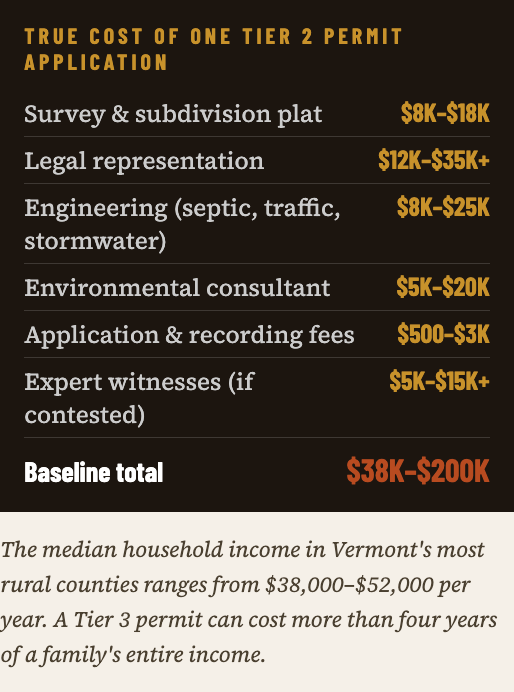
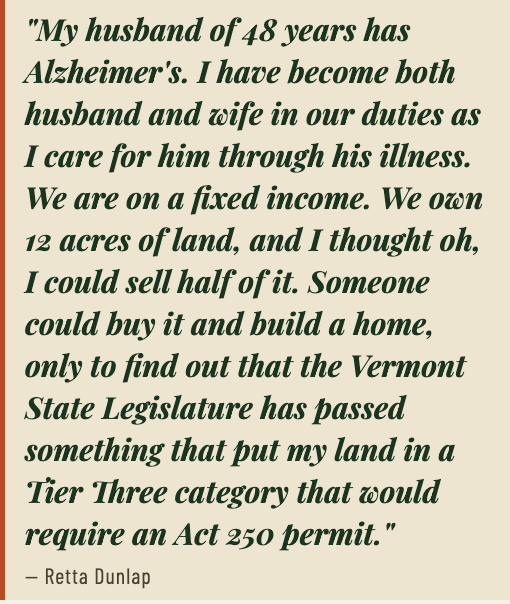
Retta's situation is far from unique. Vermont's most rural counties have median household incomes of just $38,000–$52,000 per year — yet a Tier 3 Act 250 permit can cost $75,000 to $200,000. For elderly Vermonters on fixed incomes, land is often their only financial asset — and Act 181 locks it away.
ACT 181 MAPS
Read the disclaimer and agree to it to view the map. Zoom in to your area. In the Map Layers pane on the right, click on the “Legend” icons to show the meaning of each of the color shaded areas. You have to expand each main category to check the relevant boxes (click on the little downward arrow next to the main category name). Check all the Tier 3 areas and (important) the Road Construction Jurisdiction” and “VCD Connectivity Blocks” “Reference Areas” to see just how much of Vermont is really being affected.
OTHER KEY INFO & RESOURCES
COMING SOON!
HOW YOU CAN HELP
GET INVOLVED
This is a fast-moving issue affecting communities across Vermont. Stay up to date with the latest developments, events, and voices shaping the conversation.
WRITE TO YOUR LOCAL REPS
Make your voice heard where it matters most. Contact your local and state representatives and share how Act 181 could impact you and your community.
SIGN UP TO OUR NEWSLETTER
Get the latest updates, events, and important developments delivered straight to your inbox. Stay informed and ready to act.
JOIN OUR FACEBOOK GROUP
Be part of the conversation. Stay updated, share information, and connect with thousands of Vermonters engaged in this issue.
JOIN OR START A LOCAL CHAPTER
Connect with others in your area or help start a chapter of your own. Local groups are key to building awareness and taking action on the ground.