
STORIES, ARTICLES, & NEWS ABOUT ACT 181
AN OPEN LETTER TO THE VERMONT STATE LEGISLATURE
BY HANNAH BURRILL
AN OPEN LETTER TO THE VERMONT STATE LEGISLATURE
Regarding Act 181 (H.687) — An Act Relating to Community Resilience and Biodiversity Protection Through Land Use
My name is Hannah Burrill, and I am a Vermonter. I am a neighbor, and a member of a rural community that is watching this Legislature quietly and methodically rewrite the rules of land ownership in this state — and doing so in a way that the vast majority of my fellow citizens do not yet fully understand.
I am here today not to be angry, but to be precise. I have reviewed H.687, Act 47, the tier structure documents, the road rule, the 802 Homes Catalog, and the Land Use Review Board's own February 2026 public update. What I am going to share with you today is not opinion. It is your own law, your own language, and your own record — read plainly and presented honestly.
I am asking this Legislature to do the same. Speak plainly. Because what is being done to rural Vermont deserves a plain explanation — and the people in this room deserve to hear it.
I. What This Law Actually Says — In Plain English
Act 181 has been presented to the public as a streamlined approach to housing development growth in designated areas. I want to ask this Legislature directly: designated by whom? Streamlined for whom?
The law divides the entire state into tiers. Tier 1A and 1B areas — downtowns, growth centers, village cores — receive exemptions from Act 250 review. That sounds helpful until you read what it takes to qualify. A municipality must have permanent zoning, subdivision regulations, an approved municipal plan, municipal water and sewer infrastructure, and sufficient staff capacity to administer development review. Towns like Newark, Granby, Averill, Maidstone, Glastenbury, and dozens of others across this state have none of these things. The exemption that is supposed to help rural communities is structurally inaccessible to the rural communities that need it most. It was designed for places that already don't need it.
And it is not just the smallest or most remote towns that fall through this gap. Burke — a growing, thriving, economically active community that people actively want to move to — does not yet have municipal water and sewer. Under Act 181, Burke cannot qualify for Tier 1B exemptions. Burke gets the road rule. Burke gets Tier 2 triggers. Burke gets the full weight of a permitting system designed to discourage exactly the kind of organic, community-driven growth it represents. What is Burke supposed to do? Wait? Wait for what, and for how long, and who decides when Burke has earned the right to grow on its own terms?
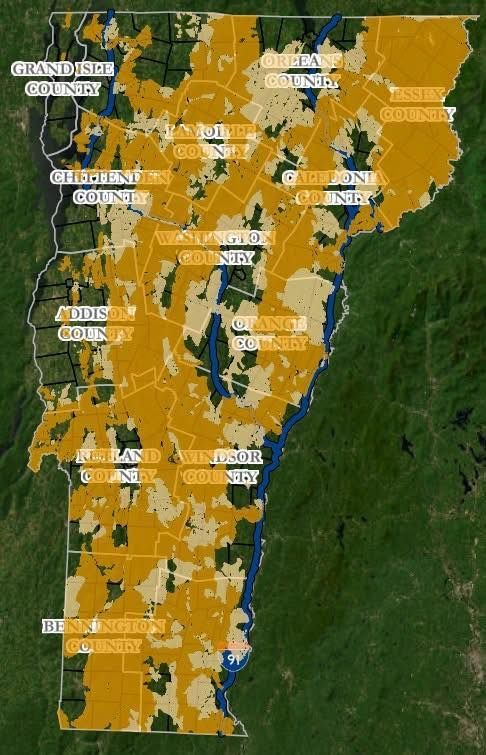
Tier 2 covers the majority of Vermont's remaining land and now carries a new jurisdictional trigger that did not exist before: the Road Rule. Written into Section 19 of H.687, this rule states that any single road exceeding 800 feet, or any combination of roads and driveways exceeding 2,000 feet, automatically triggers a full Act 250 permit review. Eight hundred feet is roughly the length of two and a half football fields. In rural Vermont, where properties are measured in acres and building sites are often set back from public roads through woods and fields, an ordinary driveway to a single family home can easily exceed that threshold.
And Tier 3 — areas designated as critical natural resources — requires a full Act 250 permit for any construction whatsoever. Commercial, industrial, or residential. One house. One garage. Full review. The boundaries of Tier 3 are defined entirely by rules written by the same board that benefits from expanded jurisdiction. The definition in the bill includes river corridors, headwater streams, habitat connectors, riparian areas, Class A waters, and natural communities. In a state where roughly 80 percent of the land is now forested, that definition could apply to an enormous percentage of rural Vermont land.
"The construction of improvements for commercial, industrial, or residential purposes in a Tier 3 area... shall require an Act 250 permit." — H.687, Section 21, 10 V.S.A. § 6001(3)(A)(xiii)
That is not streamlining. That is a reclassification of rural Vermont as a place where building a home requires the same regulatory apparatus we use to review major commercial developments.
II. Your Own Implementation Board Is Raising the Alarm
On February 20, 2026, the Land Use Review Board — the board this Legislature created to implement Act 181 — testified before the Senate Natural Resources and Energy Committee and recommended delaying its own law's implementation.
The board recommended pushing Tier 3 jurisdiction from December 31, 2026 to December 31, 2027. It recommended pushing Criterion 8C — the new forest block review standard — by one full year. It recommended pushing the road construction jurisdiction from July 1, 2026 to December 31, 2027. An 18-month delay on the road rule alone.
Why? The board's own words: Vermonters need more time to learn about and prepare for these substantive statewide land use permitting changes. Many people I have spoken with have expressed concern that their neighbors and fellow community members are unaware of these Act 250 changes.
Read that again. The board charged with enforcing this law is publicly stating that most Vermonters do not know it exists. This Legislature passed a law with sweeping consequences for rural land ownership across the entire state and the people responsible for implementing it are now telling the Senate that the public was not adequately informed. That is not an administrative footnote. That is a confession.
The board also flagged that the road rule's current start date of July 1, 2026 falls directly in the middle of Vermont's road construction season. Contractors, landowners, and families who have already planned, permitted, and budgeted for road construction this summer may find themselves subject to Act 250 jurisdiction mid-project, with no warning and no time to comply. The board knows this is a problem. They asked the Legislature to fix it. As of today it has not been fixed.
And the bill currently being drafted to address these implementation failures — S.325 — is described in its own language as providing technical clarification, transitional certainty, and implementation alignment to Act 181 without altering its underlying policy goals. Delays and technical patches are not the same as reconsidering whether this law is right for rural Vermont. The house is exactly as designed. They are just adjusting the plumbing.
III. The Real Cost to Real Vermont Families
Consider a scenario that plays out across rural Vermont every single year — in Newark, in Cabot, in Irasburg, in Craftsbury, in Readsboro, in communities across this state that will never make the evening news but are home to real families with real roots here. A parent gives their child a 10-acre parcel of land. Under current law, that child already navigates state wastewater permitting, local zoning where it exists, and any other applicable permits. It is not easy. It is not cheap. But it is possible.
Under Act 181, that same scenario — depending on where that parcel falls on a map drawn in Montpelier — may now trigger a full Act 250 permit review. Let me tell you what that actually costs.
Act 250 permit fees are calculated at $6.65 per $1,000 of construction costs, plus an additional $0.75 per $1,000 for Agency of Natural Resources review — a combined rate of $7.40 per $1,000. A family building a modest $200,000 home faces a base permit fee of approximately $1,480 before a single attorney is hired, before a single engineer is consulted, and before a single hearing is scheduled. That fee is just the entry price to a process that routinely takes months and often takes years. Add legal representation, site assessments, engineering reviews, and lost time during Vermont's short construction season, and the real cost of an Act 250 permit on a modest rural project can easily reach tens of thousands of dollars.
Notably, municipal and state projects are entirely exempt from these fees. The state builds wherever it wants at no permitting cost. You pay to build on your own land. They do not.
This is not a hypothetical concern. Neil Ryan, a third-generation Vermont farmer, has written publicly about exactly this impact on working landowners. As one Vermont legislator acknowledged plainly: if you have enough money, enough patience, and the ability to get good legal representation, you can build just about wherever you want in this state. What she was describing is a system that works for the wealthy and fails everyone else.
And this Legislature admitted in its own fiscal analysis of the road rule that a lack of data makes it unclear how many developments will fall under this rule. A new jurisdictional trigger affecting an unknown number of Vermont landowners, passed without knowing its scope, that will cost those landowners thousands of dollars to navigate. That is not responsible governance. That is legislating blindly and letting rural families bear the consequences.
IV. Vermont's Own History Dismantles the Environmental Justification
This Legislature has framed Act 181 as an environmental protection measure. I want to address that claim directly — with history.
In the mid-to-late 19th century, Vermont had been cleared of roughly 75 to 80 percent of its forest cover — primarily due to the boom and bust of sheep farming. Only about 20 to 25 percent of the state remained forested. That clearing happened without a tiered land use system, without Act 250 triggers on family parcels, and without Montpelier drawing circles on a map. Today that statistic has almost entirely reversed. Vermont is now approximately 78 to 80 percent forested — one of the most dramatic ecological recoveries in American history, confirmed by the USDA Forest Service, the University of Vermont, VTDigger, and the Vermont Historical Society.
That recovery happened organically. It happened because rural Vermonters — farmers, landowners, and families — made choices on their own land over generations. Farms consolidated. Marginal land reverted to forest naturally. The market and the landscape found their own balance. No state board mapped it. No tier system managed it. Vermont's people and Vermont's land did it together.
Vermont went from roughly 20% forested to roughly 80% forested in about 150 years — without Act 181. What crisis, precisely, is this Legislature preventing that 150 years of Vermont land stewardship could not handle on its own?
The new Criterion 8C added by H.687 states that a permit will not be granted for any development within or partially within a forest block or habitat connector unless the applicant demonstrates no undue adverse impact. The bill defines a forest block as a contiguous area of forest in any stage of succession and not currently developed for nonforest use. After 150 years of natural reforestation driven by Vermonters themselves, the overwhelming majority of rural land in towns like Brunswick, Walden, Albany, and Marshfield meets that definition. This Legislature has written a criterion that could apply to nearly any rural parcel in the state — and left the definition of what qualifies to a board that is still asking the public to help it figure out what Tier 3 even means.
V. Who Gets Exemptions — And Who Doesn't
The exemptions written into Act 181 and its road rule tell you everything about who this law was written for. Read them carefully.
- State roads are exempt.
- Municipal roads are exempt.
- Electric utility corridors are exempt.
- Roads used primarily for farming or forestry purposes are exempt.
- Tier 1A and 1B development areas are exempt.
- Every entity with institutional scale or infrastructure investment gets a carve-out.
The private landowner building a home on their own rural parcel gets none of these exemptions. I want to be clear — I have no quarrel with those exemptions existing. Farmers need to work their land. Foresters need to move timber. Utilities need to run lines. Those are legitimate Vermont industries and this letter is not a criticism of them. My criticism is of a law that extends generous protections to institutional land users while leaving individual families — the people with the least political power and the fewest resources — to bear the full weight of a permitting process that now costs them thousands of dollars to even enter.
And then Section 19(V) makes it worse: if you convert a road that was used for farming or forestry purposes to any other use, that conversion itself becomes a development trigger. A family that has worked land for generations and wants to subdivide a back parcel for their children is penalized for the access infrastructure that already exists on their property. The road that served their land for decades becomes evidence against them the moment they try to use it differently.
Meanwhile the temporary housing exemptions written into the law are available in unlimited quantities in Vermont's 24 designated downtown areas and priority housing projects in growth centers. For a designated village center the limit is 50 units. For a commercial-to-residential conversion, 29 units. The further you get from a city the smaller the exemption and the harder the requirements. By the time you reach a rural town with none of the required infrastructure you get nothing at all.
VI. This Is a Coordinated Multi-Session Plan — Not a Housing Bill
Act 181 did not appear in isolation. It is the second major piece of legislation in a deliberate, multi-session restructuring of how Vermont is governed, planned, and built — and most Vermonters have not been watching closely enough to see the full picture.
In 2023, this Legislature passed Act 47 — the HOME Act. That law mandated that every municipality create a housing element in their town plan with specific density targets set by the state. It required that any area served by municipal sewer and water must allow five or more dwelling units per acre. It gave affordable housing developments an automatic 40 percent density bonus plus an additional floor of height beyond local zoning limits. It effectively overrode local zoning decisions in every municipality with infrastructure — without most Vermonters knowing it happened.
In 2024, this Legislature passed Act 181, which restricts development outside those same infrastructure corridors through the tier system, the road rule, and the forest block criteria.
Now in 2026, the Agency of Commerce and Community Development is launching the 802 Homes Catalog — a state program producing 10 pre-approved standardized home designs for communities that demonstrate development readiness. The three pilot communities are Essex Junction, Hartford, and Manchester. Not a single rural community. Not a single town from Orleans, Essex, or Caledonia County.
The pattern is complete and it is coherent. Act 47 forces density into municipalities with infrastructure. Act 181 restricts everything outside those areas. The 802 Homes Catalog pre-designs the housing the state wants built. The state has written the zoning, designed the homes, and drawn the maps.
What exactly is left for Vermont communities to decide for themselves?
The stated purpose of Act 181 — written directly into Section 1a of H.687 — is to further assist the State in achieving the conservation vision and goals established in 10 V.S.A. § 2802. Conservation vision. Not a housing vision. Not a rural economic development vision. Conservation. Governor Scott vetoed this bill and called it plainly what it is: a conservation bill. This Legislature overrode that veto. The bill's own purpose clause proves him right.
VII. The Board That Will Decide Your Future Has Already Declared Its Values
Act 181 restructured the Natural Resources Board into the Land Use Review Board — a five-member, full-time, professional body with expanded authority over Act 250 permits, Tier 1A designations, and regional plan compliance. This board will determine what land in your town falls into Tier 3. It will write the rules defining forest blocks and habitat connectors. Its decisions will determine whether a family in Cabot or Irasburg or Burke can build a home on land their family has owned for generations.
The nominating criteria for this board are written directly into H.687. Every candidate must have a commitment to environmental justice. Not a commitment to property rights. Not a commitment to rural economic development. Not a commitment to Vermont's deep tradition of local governance and town meeting democracy. Environmental justice — a specific ideological framework — is the stated and mandatory filter through which every board member must pass.
The selection process is also largely confidential. The names of applicants are not public. The deliberations of the nominating committee are not public. The board that will make consequential decisions about rural Vermonters' land is selected through a process that rural Vermonters cannot meaningfully observe or participate in.
The Moretown planning commission chair submitted comments to the Land Use Review Board describing the Tier 3 draft maps as disproportionately disadvantaging Moretown's potential for housing development — calling it beyond demoralizing. The Vermont Chamber of Commerce has testified three times urging the Legislature to slow implementation. These are not fringe voices. These are the people closest to the ground telling you this system is not working the way you have described it to the public.
VIII. What Happens to Rural Vermont When You Make It Impossible to Build
I want to be clear about what I am not arguing. I am not arguing that Vermont needs no land use regulation. I am not arguing that environmental protection is unimportant. I am not arguing that growth centers should be left without oversight.
I am arguing that the scale of restriction being imposed on rural Vermont does not match the scale of any problem that has been documented in rural Vermont. And I am arguing that when you make it structurally impossible for families to build modest homes in small towns — and then charge them thousands of dollars just to try — those towns do not stay the same. They decline. And then they disappear.
Schools close when there are not enough children. Post offices close when there are not enough residents. Local businesses close when there are not enough customers. The volunteer fire department loses members. The town loses its selectboard candidates. The general store closes. No amount of Tier 1A exemptions in Burlington or Essex Junction will restore what is lost when Newark or Averill or Maidstone can no longer sustain the next generation.
Oregon has operated an urban growth boundary system since the 1970s — one of the closest American models to what Act 181 is attempting to build here. The results are well documented. Portland became one of the least affordable cities in the country. Rural Oregon stagnated economically while urban areas absorbed all available development. Vermont is being steered in the same direction and told it is a housing solution.
Vermont is not California. Vermont is not Oregon. We are a state of fewer than 650,000 people, the vast majority of whom live in communities that will never resemble Burlington regardless of how many state planners wish otherwise. Our rural communities are not problems to be contained. They are places where people live, where families put down roots, and where the actual Vermont — not the Vermont being designed in Montpelier — continues to exist.
IX. A Question This Legislature Must Answer On the Public Record
Before I close I want to make something very clear to this room. I am not here with a general complaint. I am here with specific evidence drawn from your own documents, your own bill language, and your own board's public statements. And I am going to ask a specific question that requires a specific answer.
I am going to state four facts from your own law and your own record. Not my interpretation. Your law. Your record.
Fact one. The stated purpose of H.687, written in Section 1a, is to achieve the conservation vision and goals of the State. Not the housing vision. Not the rural development vision. The conservation vision.
Fact two. Every unlimited housing exemption in this law applies exclusively to designated downtown areas and growth centers. Outside those areas exemptions shrink, requirements multiply, and eventually disappear entirely for communities that cannot meet the infrastructure threshold.
Fact three. The 802 Homes Catalog — your own agency's housing program — is being piloted in Essex Junction, Hartford, and Manchester. Not one rural community was selected.
Fact four. The Land Use Review Board — the board you created to implement this law — testified before the Senate on February 20, 2026 and stated publicly that most Vermonters are unaware of these changes. The board you trusted to implement Act 181 is telling your own Senate committee that the people most affected by it don't know it exists.
Those are your facts. Written by you. Funded by you. Testified to by your own board.
So here is my question — and I am asking for a specific answer, not a general statement of intent:
Can you identify — by page number and section — any provision in H.687 that affirmatively protects and expands the right of a Vermont family to build a modest home on rural land outside a designated growth center, without triggering Act 250 review, without a multi-year state approval process, and without infrastructure requirements their town does not have and cannot afford?
Not a promise. Not a principle. A specific provision. Page and section number.
If that provision exists, read it to this room right now. Every person here who owns rural land or hopes to build on it is waiting to hear it.
If it does not exist — and I have reviewed this bill carefully and I do not believe it does — then I need this Legislature to answer a different question on the public record, in plain English, in front of the Vermonters in this room:
Is it the deliberate policy of this Legislature to concentrate Vermont's future development within designated urban growth centers and restrict it everywhere else — yes or no?
Because if the answer is yes, say it. Say it clearly. Say it to the people in this room who own land in Newark and Burke and Granby and Cabot and Averill who will be directly affected by that policy. They deserve to know what has been decided about their future. They deserve to hear it from you directly instead of reading it buried in 179 pages of statutory language.
And if the answer is no — if this Legislature genuinely does not intend to restrict rural Vermont development — then explain to this room why your own purpose clause says conservation, why your own exemptions exclude rural towns, why your own board is delaying implementation because the public doesn't know the law exists, and why not a single provision in H.687 affirmatively protects the right of a rural Vermont family to build on their own land.
There is no answer to that question that does not require this Legislature to either own this vision openly or acknowledge that this law needs to be fundamentally rewritten.
X. My Demand
I am calling on this Legislature to repeal Act 181 or fundamentally overhaul it so that its restrictions apply where the problems it claims to address actually exist. Restrict development where the housing pressure and greenspace loss are documented and real — in Chittenden County, in Burlington's watersheds, in the communities that have genuinely overdeveloped and asked for intervention.
But stop treating a family's 10 acres in Newark the same as a 500-unit development on the edge of a city. Stop drawing maps from offices in Montpelier that determine what a landowner in the Northeast Kingdom can build on property their grandparents cleared by hand. Stop calling it streamlined when what you mean is restricted. Stop calling it a housing bill when your own purpose clause says it is a conservation bill. And stop implementing it quietly while the people most affected by it are, by your own board's admission, unaware that it exists.
Rural Vermont is not a problem to be solved. It is not a forest block to be preserved from the people who live in it. It is home. And the people who call it home deserve a Legislature that treats their land, their families, and their futures with the same respect it extends to every designated downtown in this state.
Respectfully and without reservation,
_______________________________
Hannah Burrill
Burke, Vermont
Spring 2026
Sources Referenced
H.687 — An Act Relating to Community Resilience and Biodiversity Protection Through Land Use (Act 181, 2024), Vermont Legislature
Act 47 — An Act Relating to Housing Opportunities Made for Everyone (HOME Act, 2023), Vermont Legislature
NRC Summary of Act 250 Jurisdictional Tiers and Designation Process, Vermont Natural Resources Board
802 Homes Catalog — Homes for All Initiative, Vermont Agency of Commerce and Community Development (2026)
Ryan, Neil — "Act 181 Is Ending Small Vermont Farms and Most Vermonters Don't Even Know It," Vermont Daily Chronicle
Land Use Review Board — February/March 2026 Public Update on Tier 3 Rulemaking and Road Construction Jurisdiction
Act 250 Permit Fee Schedule — Vermont Land Use Review Board, Vermont.gov
Vermont Forest Cover Historical Data — USDA Forest Service; University of Vermont; VTDigger; Vermont Historical Society; The Orianne Society
Act 250 Program & History, Vermont Land Use Review Board — act250.vermont.gov
share this
MORE READING MATERIAL
Related Articles
STAY UP TO DATE
sign up to our newsletter
Receive bi-weekly updates about the latest news about Act 181
Contact Us